Google Sheets Sync for WhatsApp Leads: Why We Retired It (and What Replaced It)
Waslo's Google Sheets sync for WhatsApp leads has been discontinued. Here's why, and how to get the same visibility today with CSV export and webhooks.
Last reviewed: Sep 27, 2026
Reviewed by: Waslo Team
Key takeaways
- Google Sheets sync is no longer part of Waslo — it was removed during a security-driven narrowing of our Google OAuth scopes.
- CSV export (on-demand, from the Leads page) and an inbound webhook now cover the same lead-visibility workflows sync used to.
- Both replacements carry the lead's classification and topic, so nothing about pipeline visibility was lost — only the always-on Google Sheets connection.
Update (2026-09-12): Google Sheets sync is no longer part of Waslo. It was removed during a security-driven narrowing of our Google OAuth scopes and is not coming back in this form. If you're here to get your WhatsApp lead data into a spreadsheet or another tool today, use CSV export from the Leads page (on-demand, includes classification and topic) or connect an inbound webhook to push lead data to your own systems or CRM in real time. The rest of this article is kept as a reference for how the old Google Sheets sync workflow used to work.
Why Google Sheets Is Still the Best CRM for Most Businesses
There is a paradox in business software: the more powerful a CRM gets, the less likely your team is to actually use it. Salesforce has thousands of features. HubSpot can track every micro-interaction across every channel. But ask most small and mid-sized business owners what they use to manage their leads, and the honest answer is usually a spreadsheet.
There is no shame in that. Google Sheets is powerful, free, collaborative, and familiar. Every person on your team already knows how to use it. There is no training period, no onboarding, no per-seat licensing fee. You open a sheet, see your data in rows and columns, filter and sort as needed, and share with anyone via a link.
The problem is not that Google Sheets is a bad tool for lead management. The problem is getting the data into it. When your leads come through WhatsApp conversations handled by an AI agent, manually copying lead names, phone numbers, and classifications into a spreadsheet defeats the purpose of automation.
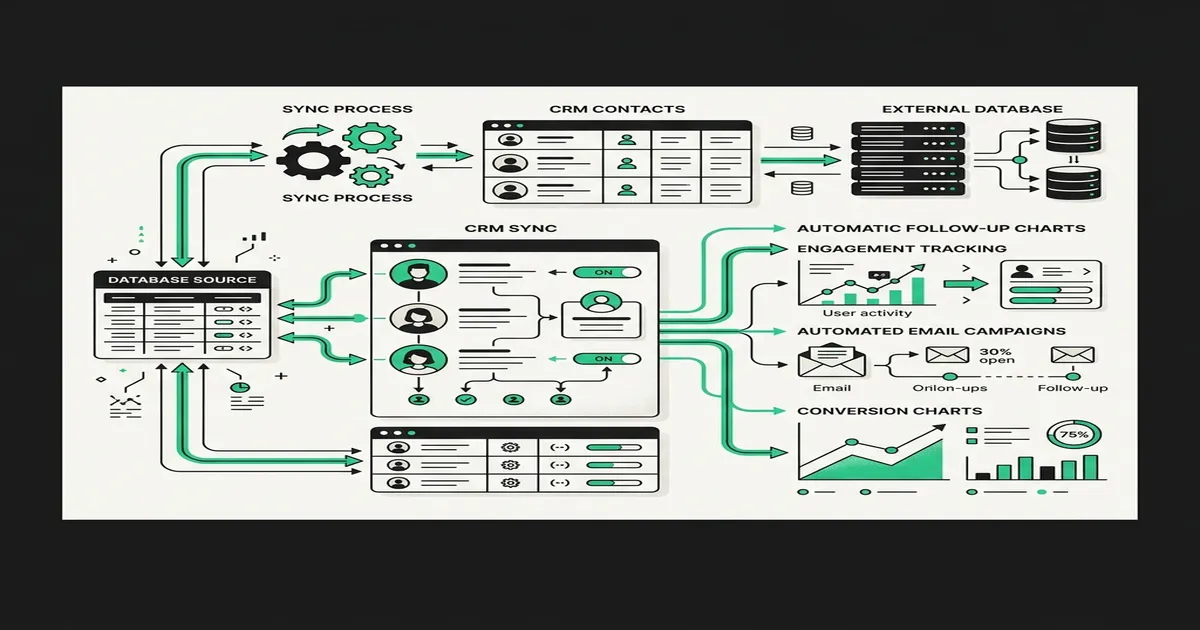
That is where automatic sync comes in. Your AI agent handles WhatsApp conversations, classifies leads, and manages follow-ups — and all of that data flows into Google Sheets automatically, in real time, without anyone copying and pasting.
What Gets Synced
When you connect Google Sheets to your WhatsApp AI agent platform, the sync includes all the data you need to manage your pipeline:
Lead Information
- Name — pulled from the WhatsApp profile or extracted from conversation
- Phone number — the lead's WhatsApp number
- Status — current pipeline stage (New, Contacted, Qualified, Booked, Cold, Archived)
- Classification — AI-assigned classification (HOT, WARM, COLD, or Unclassified)
- First contact date — when the lead first messaged you
- Last message date — when the last interaction occurred
Conversation Context
- Message count — how many messages have been exchanged
- Needs attention — whether the lead is flagged for human follow-up
- Handoff reason — if the lead requested a human or triggered a handoff keyword
- Follow-up count — how many automated follow-ups have been sent
AI Insights
- Classification reasoning — why the AI scored the lead as HOT, WARM, or COLD
- Key topics discussed — extracted from conversation analysis
This data updates automatically as conversations progress. When a lead's classification changes from WARM to HOT, your spreadsheet reflects it. When a follow-up is sent, the follow-up count increments. No manual updates required.
The Power of Spreadsheet-Based Lead Management
Once your WhatsApp leads are flowing into Google Sheets automatically, you unlock a set of workflows that are surprisingly powerful:
Real-Time Pipeline Visibility
Open your sheet and instantly see your entire lead pipeline. Sort by classification to see all HOT leads at the top. Filter by status to find leads that are Qualified but not yet Booked. Search by date to find leads from this week's marketing campaign. This takes seconds, requires no special training, and works on any device.
Team Collaboration
Share the sheet with your sales team, your marketing team, and your management. Everyone sees the same data in real time. Sales managers can monitor pipeline health without asking for reports. Marketing can see which campaigns are generating HOT leads. The entire team operates from a single source of truth.
Custom Reporting
Google Sheets has built-in pivot tables, charts, and conditional formatting. Create a dashboard that shows:
- HOT leads by week (is your pipeline growing?)
- Conversion rates by source (which campaigns work?)
- Average time from first contact to classification (how fast is your qualification?)
- Follow-up effectiveness (how many COLD leads re-engage?)
These reports update automatically as new data syncs in. No BI tools needed.
Integration with Everything
Google Sheets connects to virtually every business tool through native integrations, Zapier, or Make (formerly Integromat). Sync your sheet to:
- Mailchimp or SendGrid — add leads to email nurture sequences
- Google Data Studio — create visual dashboards for stakeholders
- Slack — get notifications when certain conditions are met (e.g., a new row with classification = HOT)
- Google Calendar — auto-create calendar events for booked leads
- Your actual CRM — if you do use Salesforce or HubSpot, Sheets can serve as a bridge
This "Google Sheets as middleware" approach is incredibly flexible. You get the simplicity of a spreadsheet for day-to-day management and the power of integrations for advanced workflows.
Historical Data and Trends
Unlike a dashboard that shows current state, a spreadsheet preserves history. Every lead that has ever messaged you is a row in the sheet with a timestamp. Over months, this becomes a valuable dataset for analyzing:
- Seasonal patterns in lead volume
- Changes in lead quality over time
- The long-term impact of prompt or classification changes
- Customer lifetime patterns (leads who went COLD and later came back)
Setting Up Google Sheets Sync: Step by Step
Here is how to connect Google Sheets to your Waslo WhatsApp AI agent.
Prerequisites
- A Waslo account on either plan — PAYG (pay-as-you-go credits) or Growth ($149/month). (Historical: this was true while Sheets sync was live. Today, use CSV export or an inbound webhook instead — both work on either plan.)
- A Google account with access to Google Sheets
- At least one WhatsApp number connected and receiving leads
Step 1: Navigate to Integrations
In your Waslo dashboard, go to Integrations and find the Google Sheets section.
Step 2: Connect Your Google Account
Click Connect Google Sheets and authorize Waslo to access your Google Sheets. The authorization is scoped to only the specific spreadsheet used for sync — Waslo does not access your other Google Drive files.
Step 3: Create or Select a Spreadsheet
You can either create a new spreadsheet specifically for Waslo leads or select an existing one. If you create a new one, Waslo automatically sets up the column headers. If you use an existing sheet, make sure the column structure matches the expected format.
Step 4: Configure Sync Settings
Choose your sync preferences:
- Auto-sync — New leads and updates sync automatically as they happen
- Manual sync — You trigger syncs on demand from the dashboard
- Sync direction — Waslo supports syncing leads from your platform to Sheets
For most users, auto-sync is the right choice. Your sheet stays current without any action on your part.
Step 5: Trigger Initial Sync
Click Sync Now to perform an initial sync of all existing leads. Depending on how many leads you have, this may take a few seconds to a minute. Once complete, your spreadsheet will contain every lead with full details.
Going forward, new leads and updates sync automatically.
Practical Use Cases
Use Case 1: Weekly Sales Meeting
Every Monday morning, your sales manager opens the Google Sheet, filters for leads from the past week, and sorts by classification. In 30 seconds, they have a clear picture:
- 12 new HOT leads (who is handling each one?)
- 28 WARM leads (which ones are closest to converting?)
- 45 COLD leads (how many re-engaged after follow-ups?)
No dashboard login needed. No report generation. Just a spreadsheet that everyone on the call can see simultaneously.
Use Case 2: Marketing Campaign Analysis
You ran a Facebook Click-to-WhatsApp ad campaign last week. You want to know if the leads it generated are high quality. Filter the sheet by date range (last week) and look at the classification breakdown:
- 40% HOT — great campaign
- 35% WARM — solid, needs nurturing
- 25% COLD — expected for any campaign
Compare this with the previous week's organic leads. If the ad campaign generated a higher percentage of HOT leads, scale it up. If not, adjust your targeting.
Use Case 3: Lead Assignment
For teams with multiple salespeople, the Google Sheet becomes a simple lead assignment tool. Add a "Assigned To" column, and team members claim leads by entering their name. Managers can see at a glance who is handling what and whether any HOT leads are unassigned.
Use Case 4: Customer Follow-Up Tracking
The sheet shows follow-up count and last message date for each lead. Filter for leads where the last message was more than 7 days ago and follow-up count is less than 3. These are leads that the automated system has not yet fully engaged. A quick manual review can identify whether they need a personal touch or can continue in the automated pipeline.
Use Case 5: Integration with Email Marketing
Connect your Google Sheet to Mailchimp using Zapier. When a new row appears with classification = WARM, automatically add that contact to a nurture email sequence. When classification changes to HOT, move them to a "ready to buy" segment. Your WhatsApp AI agent qualifies leads, and your email system nurtures them in parallel.
Use Case 6: Executive Reporting
Create a separate tab in your sheet with pivot tables and charts. Total leads by classification, leads by week, conversion funnel metrics — all auto-updating. Share a view-only link with your CEO or investors. They get a real-time dashboard without needing access to your Waslo account.
Import Leads From Google Sheets
Sync is not just about exporting data. If you have an existing list of leads in a spreadsheet — from a trade show, a purchased list, or a previous CRM — you can import them into Waslo.
Upload your CSV or connect your existing Google Sheet, map the columns (name, phone number, status), and import. These leads appear in your Waslo dashboard ready for your AI agent to engage with when they message you, or for your team to reach out to proactively.
This is especially useful for businesses transitioning from manual WhatsApp management to an AI-powered system. You do not lose your existing leads — you bring them into the new system and let the AI take over from there.
Google Sheets vs. a Full CRM
Let us be honest about when Google Sheets is enough and when you might need more.
Google Sheets Is Enough When:
- Your team has fewer than 10 salespeople
- Your sales process has 3-6 stages
- You need basic filtering, sorting, and reporting
- Your integrations are simple (email, calendar, basic automation)
- You want zero learning curve and zero additional cost
- You value flexibility and simplicity over advanced features
Consider a Full CRM When:
- You have complex multi-touch sales processes with dozens of stages
- You need advanced automation (lead scoring models, predictive analytics)
- Compliance requires detailed audit trails and access controls
- Your team has 20+ salespeople who need territory management
- You are already paying for and actively using a CRM
The good news is that these options are not mutually exclusive. Many Waslo users start with Google Sheets and only move to a full CRM when their volume and complexity genuinely demand it. And even then, the CRM webhook integration means Waslo can push lead data to any CRM with an API endpoint.
Tips for Organizing Your Lead Sheet
Column Structure
A clean column structure makes your sheet easy to scan and filter:
| Column | Purpose |
|---|---|
| Name | Lead's name from WhatsApp |
| Phone | Phone number |
| Status | Pipeline stage |
| Classification | HOT / WARM / COLD |
| First Contact | Date of first message |
| Last Message | Date of last interaction |
| Messages | Total message count |
| Follow-Ups | Number of auto follow-ups sent |
| Needs Attention | Yes/No flag |
| Notes | Manual notes from your team |
Conditional Formatting
Apply conditional formatting to make hot leads visually pop:
- HOT classification: red background
- WARM classification: orange background
- COLD classification: blue background
- Needs Attention = Yes: bold text with yellow highlight
This turns your spreadsheet into a visual dashboard where priority leads are immediately obvious.
Separate Tabs for Stages
Consider using separate tabs for different pipeline stages:
- Active Leads — New, Contacted, Qualified
- Booked — Leads with confirmed appointments or orders
- Archived — Closed or unresponsive leads
- Dashboard — Pivot tables and charts
Use IMPORTRANGE or FILTER formulas to automatically populate each tab from the main data sheet.
Regular Cleanup
Once a month, review your sheet for leads that have been COLD and unresponsive for more than 30 days. Archive them to keep your active sheet focused. This is not about giving up on those leads — they stay in your system — but about keeping your working view clean and manageable.
The Complete Data Flow
Here is how data flows through the entire system:
- A prospect messages your WhatsApp number
- Your AI agent responds, qualifies, and classifies the lead
- Lead data (name, phone, classification, status) syncs to Google Sheets automatically
- As the conversation progresses, the sheet updates in real time
- If the lead is classified as HOT, your team gets a Telegram notification
- Your team takes over in the Waslo dashboard, closes the deal
- The sheet reflects the status change to Qualified or Booked
- Monthly, you review the sheet for trends and insights
Every step is automated except the ones where human judgment adds value: closing deals and strategic review. That is the point. The AI agent does the work. Google Sheets captures the data. Your team makes the decisions.
Pricing Consideration
Waslo has just two plans. (This section described Google Sheets sync pricing while the feature was live; today, the equivalent — CSV export and inbound webhooks — works the same way on both plans, at no extra cost.)
- Pay-As-You-Go (PAYG) — $0/month base, no card and no subscription required. You get 75 free credits on signup and one WhatsApp number free (each extra number is a one-time 1,500-credit activation). Credits are the license, so you only pay for what you use.
- Growth — $149/month ($119/month billed annually). Unlimited messaging, all channels included, 3 WhatsApp numbers with per-number configuration, and priority support — ideal for teams scaling their WhatsApp sales operations.
There is no free trial because the 75 free credits on PAYG already let you run real AI conversations and test CSV export before you pay anything. When you outgrow credits, you can switch to Growth from the Billing section of your dashboard — all your existing leads, conversations, and settings are preserved.
CSV export and inbound webhooks are included at no additional or per-message cost on either Waslo plan.
Ready to Get Started?
Waslo gives you an AI-powered WhatsApp agent with flat pricing, zero per-message fees, and setup in under 2 minutes. No WhatsApp Business API required — just scan a QR code and go live.
Start free today — 75 free credits on signup, no card needed.