The future of whatsapp for business in 2027: What Smart Teams Need to Understand in 2026
Explore the future of WhatsApp for business in 2027, with practical numbers, operating models and planning advice for teams running WhatsApp AI agents.

Last reviewed: Sep 27, 2026
Reviewed by: Waslo Team
Key takeaways
- The future of whatsapp for business in 2027 is not just a technology discussion; it changes economics, staffing expectations, and the pace at which businesses can operate on WhatsApp.
- The smartest teams compare not only features, but also implementation overhead, compliance exposure, and the quality of the customer experience.
- In most cases, the strategic advantage comes from reducing friction while keeping trust, control, and measurable business outcomes intact.
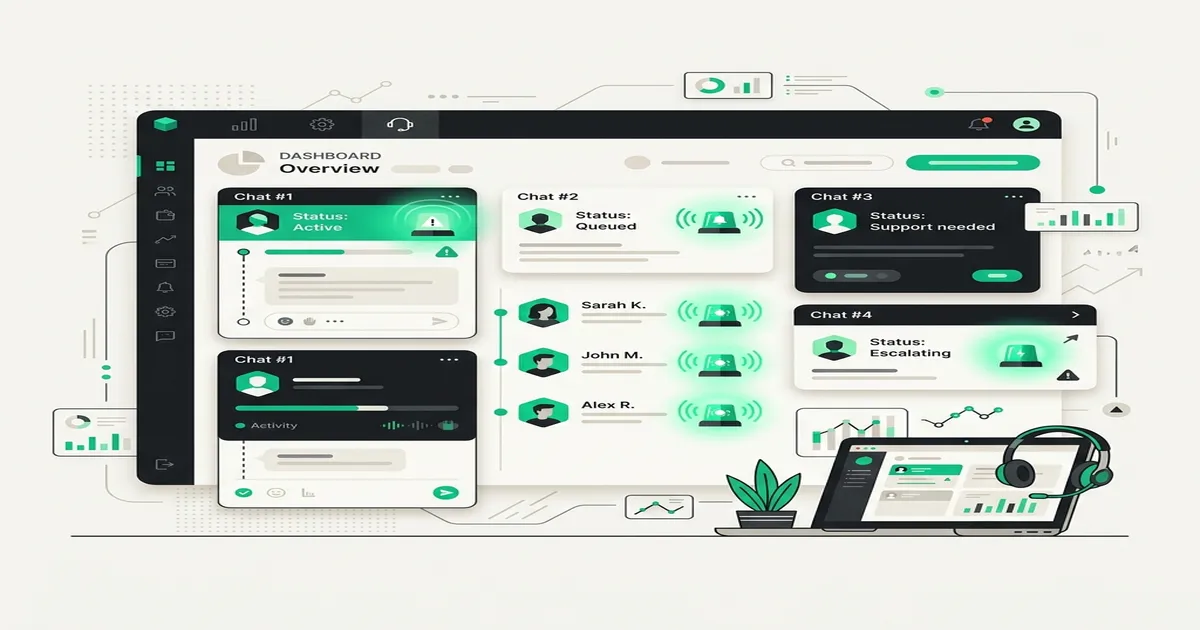
The future of WhatsApp for business in 2027 is about redesigning service, sales, and coordination around fast conversational workflows instead of slow queues or disconnected tools. Smart teams treat WhatsApp as a core operating channel — one AI agent that answers in seconds, captures context, escalates cleanly to humans, and increasingly works across every channel a customer uses, not WhatsApp alone.
Why this matters in practice
The teams that treat WhatsApp as a serious operating channel are no longer asking whether conversational automation matters. They are asking how to redesign their service and revenue workflows around it. That is why the future of WhatsApp for business in 2027 is a planning topic, not just a technology topic. The important questions are how fast the first reply arrives, how much context the AI agent can carry, how cleanly the system escalates, and how much manual work the team can remove without hurting trust.
Most strategic decisions improve when they are tied to numbers. Teams should compare at least 5 metrics: first-response time, conversations resolved end to end by the AI agent, human handoff rate, conversion or resolution lift, and the labor hours saved each week. Those measures turn hype into operational truth. If you want to go deeper, explore our guide to team productivity with WhatsApp AI agents, read our guide to WhatsApp AI agents vs call centers, and follow our guide to building a WhatsApp AI agent.
What the workflow should look like
In practice, the strongest operating model usually combines 24/7 first response, structured data capture in the first 3 to 5 prompts, clear human handoff for exceptions, and regular review of outcomes every 7 or 14 days. The shift is not only technological. It is organizational. Managers need to define who owns service rules, what the AI agent is allowed to answer, and which exceptions require immediate escalation.
This is why themes like AI-led first response, tighter CRM integration, more multimodal buying journeys, higher expectations for instant service, and leaner teams with more automation matter. Each one changes the economics of the channel. Faster response means less lost demand. Better context means shorter handling time. Cleaner routing means humans spend more time on decisions and less on repetition.
Decision table
| Strategic question | Weak approach | Strong approach |
|---|---|---|
| First response | Wait for an available agent | AI agent responds in under 1 to 5 minutes |
| Context capture | Ask humans to reconstruct the case | Capture structured data early |
| Escalation | Transfer without rules | Escalate only clear exceptions |
| Measurement | Count messages only | Track conversion, resolution, and labor impact |
| Planning | Treat WhatsApp as a side channel | Treat it as a core operating layer |
A table like this makes the trend concrete. Teams do not gain leverage by adding AI vocabulary to the same old queue. They gain leverage when the whole workflow is redesigned for speed, context, and intelligent routing.
Practical example
Consider a regional company redesigning support and sales for 2027. In the old model, coverage is tied to staff availability, handoff is inconsistent, and managers struggle to explain where the cost of delay really comes from. The organization may still hit message-volume goals while underperforming on conversion or resolution quality.
In a redesigned model, the AI agent protects the first-response window, captures structured context, and hands the conversation to people only where trust, negotiation, compliance, or complexity truly matter. That single shift can reduce queue pressure, shorten time to value, and make performance easier to manage across every shift.
How Waslo Helps
Waslo helps because it is built around the operating model described above. It is a multi-channel AI agent — one Waslo AI brain that works across WhatsApp QR (WhatsApp Web, no Business API required), WhatsApp Cloud API, Telegram, Instagram, Messenger, and Outlook email (Gmail in early access) — with lead classification, human handoff, follow-up logic, calendar booking (Google Calendar and Cal.com), a Knowledge Base with cited answers, and analytics designed to support real teams. The AI Reasoning Panel even shows what the agent used for each reply. That makes strategic planning more realistic because the business can connect the idea directly to execution.
Waslo pricing is straightforward, with only two plans. PAYG starts at $0/mo and includes 75 free credits on signup with no card required — that is the try-before-you-pay path, with every feature except the four Growth-only ones (voice replies, the built-in catalog editor, WhatsApp group mode, and topics & team routing), one WhatsApp number free, and +1,500 credits per extra number. Growth is $149/mo ($119/mo billed annually) for unlimited messages, multimodal AI, three numbers, and every channel included. There is no free trial period — the 75 free credits are how you test the product before paying. On WhatsApp QR, Telegram, Instagram, Messenger, and email there are no per-message fees; only official WhatsApp numbers carry Meta's own per-message charges. Predictable pricing matters when leadership is trying to compare automation gains against labor cost, queue pressure, and growth targets.
Common mistakes and implementation notes
The biggest mistake is discussing strategy without specifying the workflow. Leadership teams often talk about AI, productivity, or the future of service in abstract terms. But abstract strategy does not tell frontline teams who answers first, what gets measured, or when a conversation must reach a human. Another mistake is treating compliance and trust as afterthoughts. Governance, access control, and escalation rules must be designed before the volume rises, not after.
What to measure in the first 30 days
The first 30 days should be treated as a measurement sprint, not a publishing milestone. Teams often go live, celebrate the launch, and then fail to check whether the workflow is actually creating faster replies, cleaner qualification, or better conversion. For a topic like future of whatsapp business 2027, the minimum scorecard should include at least 5 metrics: first-response time, completion rate of the AI-led flow, handoff rate, follow-up recovery rate, and the amount of manual handling time saved per shift. The goal is not to prove that the system sends messages. The goal is to prove that the right conversations move faster, with fewer delays and fewer dropped steps.
The strongest teams also compare before-and-after baselines every week. If first response drops from 25 minutes to 3 minutes, if the AI agent resolves or advances 30% to 60% of routine conversations, or if the human team saves 5 to 10 hours a week, the workflow is doing real work. If those numbers do not move, the business should refine prompts, adjust qualification logic, or revisit handoff rules. This is also where supporting material like review our WhatsApp Business API pricing guide becomes useful, because pricing, setup logic, and evaluation criteria all shape what “good” performance actually looks like.
Rollout checklist
A practical rollout checklist keeps the team from overbuilding. Start with one owner, one primary workflow, and one clear escalation path. Limit the first version to 3 or 4 common scenarios, define who approves changes, and document which customer questions the AI agent should answer without hesitation. Then test the workflow on real conversations, not just internal examples. In most cases, the launch should include after-hours coverage, one follow-up rule at 24 hours, one second reminder if appropriate, and a clear pause condition when a human joins the thread.
It also helps to review the content layer before traffic scales. Are pricing references current? Are availability rules clear? Is the AI agent collecting the minimum useful context instead of asking long forms inside chat? If the answer is no, the team should fix those issues before expanding the scope. For many businesses, a better plan is to win one flow convincingly, then expand to adjacent workflows using related implementation guidance like read our guide to WhatsApp AI agents vs call centers. That sequencing prevents the channel from feeling automated in the wrong way.
Risks to avoid as volume grows
The biggest risk as volume grows is silent quality drift. A workflow that performs well at 20 conversations per day can fail at 200 if the business does not update pricing, availability, escalation logic, or FAQ coverage. Another risk is measuring the wrong thing. Message count may rise while actual outcomes stay flat. That is why teams should watch conversion, resolution quality, and the percentage of conversations that still require manual clean-up after the AI agent has done its part.
A second scaling risk is governance. If nobody owns prompt changes, routing rules, or the criteria for human handoff, the system slowly becomes inconsistent. The safest model is a weekly review rhythm, a named owner, and a small backlog of improvements tied to real conversation evidence. Businesses that treat WhatsApp as a living operating channel, rather than a one-time automation project, usually get much stronger long-term results.
What to measure in the first 30 days
The first 30 days should be treated as a measurement sprint, not a publishing milestone. Teams often go live, celebrate the launch, and then fail to check whether the workflow is actually creating faster replies, cleaner qualification, or better conversion. For a topic like future of whatsapp business 2027, the minimum scorecard should include at least 5 metrics: first-response time, completion rate of the AI-led flow, handoff rate, follow-up recovery rate, and the amount of manual handling time saved per shift. The goal is not to prove that the system sends messages. The goal is to prove that the right conversations move faster, with fewer delays and fewer dropped steps.
The strongest teams also compare before-and-after baselines every week. If first response drops from 25 minutes to 3 minutes, if the AI agent resolves or advances 30% to 60% of routine conversations, or if the human team saves 5 to 10 hours a week, the workflow is doing real work. If those numbers do not move, the business should refine prompts, adjust qualification logic, or revisit handoff rules. This is also where supporting material like review our WhatsApp Business API pricing guide becomes useful, because pricing, setup logic, and evaluation criteria all shape what “good” performance actually looks like.
Rollout checklist
A practical rollout checklist keeps the team from overbuilding. Start with one owner, one primary workflow, and one clear escalation path. Limit the first version to 3 or 4 common scenarios, define who approves changes, and document which customer questions the AI agent should answer without hesitation. Then test the workflow on real conversations, not just internal examples. In most cases, the launch should include after-hours coverage, one follow-up rule at 24 hours, one second reminder if appropriate, and a clear pause condition when a human joins the thread.
It also helps to review the content layer before traffic scales. Are pricing references current? Are availability rules clear? Is the AI agent collecting the minimum useful context instead of asking long forms inside chat? If the answer is no, the team should fix those issues before expanding the scope. For many businesses, a better plan is to win one flow convincingly, then expand to adjacent workflows using related implementation guidance like read our guide to WhatsApp AI agents vs call centers. That sequencing prevents the channel from feeling automated in the wrong way.
Risks to avoid as volume grows
The biggest risk as volume grows is silent quality drift. A workflow that performs well at 20 conversations per day can fail at 200 if the business does not update pricing, availability, escalation logic, or FAQ coverage. Another risk is measuring the wrong thing. Message count may rise while actual outcomes stay flat. That is why teams should watch conversion, resolution quality, and the percentage of conversations that still require manual clean-up after the AI agent has done its part.
A second scaling risk is governance. If nobody owns prompt changes, routing rules, or the criteria for human handoff, the system slowly becomes inconsistent. The safest model is a weekly review rhythm, a named owner, and a small backlog of improvements tied to real conversation evidence. Businesses that treat WhatsApp as a living operating channel, rather than a one-time automation project, usually get much stronger long-term results.
Final takeaway
The future of whatsapp for business in 2027 matters because businesses are shifting from channel presence to workflow quality. The winners will be the teams that use WhatsApp AI agents to protect speed, preserve context, and focus human effort where it creates the most value.